Showing posts with label Retailer Own Brands. Show all posts

Sunday, 23 September 2012

The Changing Face of Private Label


Ever since the 1980’s when Loblaws Canada introduced a premium private label “Decadent” chocolate chip cookie which tasted miles better than any branded equivalent, private label has ceased to be a poor relation and became a potent weapon in the retailers armoury.

Once an inferior substitute for brands, private label marketing  evolved into the well known tiering strategy of “good, better, best” with most attention paid to “best” because those were days of affluence when consumers shelled out vast sums regardless of whether the quality justified the price, and were happy to pay for the premium label.

Now, in a very different economic  climate retailers are once again rethinking their strategies.
They face multiple challenges to keep customers, and grow sales and profits.

Shopping behaviour is well documented, and few who are interested in the food industry will be unaware of the consumer search for value, and the increasingly creative ways that retailers are responding, like cheaper petrol,  money off in store, bogofs (buy one get one free) or “threefers”, (three for the price of two).

The biggest battle ground has been branded goods. Whether it is Sainsbury’s promise to refund if a branded shop on a given day could be bought cheaper at Tesco or ADSA, ASDA’s promise to be 10% cheaper, Waitrose’s promise to match Tesco on branded goods ( promotional activity excepted), orTesco’s penchant for price promoting, branded goods have become the punchbag of shopping. As a result, depite the pressure put on branded manufactures to fund promotions, retailers are struggling to make profit from branded goods.  
The question facing retailers is how to keep sales and profits rolling, and the answer is through private label.
Private label offers flexibility to address the needs of most shoppers from affluent to cash strapped.  If it gets the quality/price/taste equation right it can be a tremendous tool for generating loyalty. And it does this in an environment where price comparisons between stores are difficult, bordering on  impossible.

So we see £millions being poured into private label development, at the value end of the spectrum where, according to Kantar Worldpanel sales of value lines are rocketing, up 13% in May 2012 compared just 1% last year, and at the premium end which has traditionally been a source of substantial profit but has seen sales performance swing from +10% last year to minus 1% in June of this.

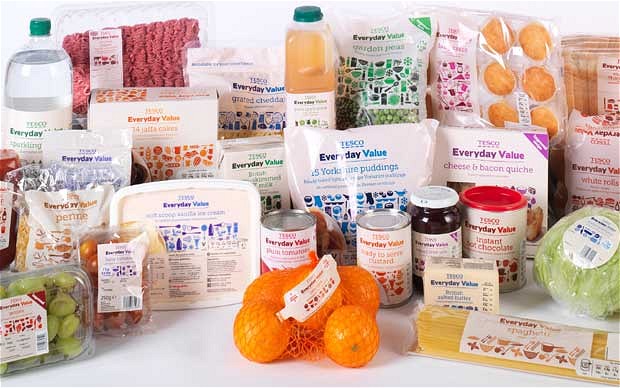
The range of value products is growing as are retailers efforts to explain to customers why they represent a good buy. Tesco say they “are proud to bring you Everyday Value – quality and value for everday eating, cooking and living”. Morrisons M Savers go flat out on communicating price, and visitors to their website are guided by price bands – under 30p, under 50p, and under £1.

At the other end, retailers are busy developing premium ranges that rely on provenance and quality of ingredients, like Sainsbury pasta which comes from a family firm in Puglia, Italy. Morrisons M Kitchen ready meal range has been developed by celebrity chefs.

Private label is also good for retailers in that, with the exception of Morrisons they own few production assets relying instead on suppliers to make the products. So if an idea does not work they do not bear the burden of factories lying idle, or workers laid off because demand was less than hoped.

Expect to see the private label battle intensify over the coming months, and branded suppliers to do much head scratching about how to fund both advertising to keep their brands front of mind with consumers, and cut price promotions demanded by retailers.


Friday, 20 July 2012

Spectacular Increase in Lamb Eating as Supermarkets Cut Prices - But Still a Premium Meat Needing Premium Marketing


Lamb eating in the UK has grown for the first time in over three years. 

According to KantarWorldPanel data for the 12 weeks ending 10th June volume sales of lamb grew by 16%. This reverses a severe downward trend, with sales at one time looking as if they were in free fall. Indeed, annual sales of fresh and frozen lamb through supermarkets have dropped from around 101,000 tonnes in 2008 to 70,000 tonnes today. (Source: World panel/EBLEX).

Renewed growth is welcome news to sheep farmers for the halcyon days of high lamb prices caused by the weakness of the £ versus the euro are behind us at least for the foreseeable future, and a strong domestic demand is needed to ensure that prices do not fall to unsustainable levels.
Predictably, the main reason for higher consumption is a drop in retail price. In the 12 weeks under review the average price of a kilo of lamb reduced from £8.22p to £8.08p as supermarkets promoted the product over Easter and in the run up to the Jubilee. Sales were also helped by the rocketing price of beef in the shops. The gap between the average price of a kilo of beef versus lamb has narrowed to around £1 a kilo versus £1.92 a year ago.

£8 a kilo is not cheap. Lamb remains a premium priced product out of the reach of many. And there has been sobering news on the premium food front. According to Kantar World panel, sales of supermarket own brand premium ranges, like Sainsbury’s Taste the Difference or Tesco’s Finest, have declined for the first time since 2008. It had seemed that consumers were willing, despite the general price of food rising, to keep buying premium food as long as they felt the quality justified the price. Now they are thinking twice, and in the last 12 weeks sales of premium own brand ranges have dropped by 6%. By contrast, sales of value ranges have soared, up 13%.

Further signs of belt tightening come in the form of below inflation sales through supermarkets – down 0.7% in June 2012 compared with June 2011, and the well documented performance of discounters Aldi and Lidl who continue to grow, up 26% and 11% respectively.

The increase in lamb eating is good news, and it is hoped but not expected that supermarkets will keep the price of lamb at these lower levels to encourage consumption.

What is urgently needed is a total rethink about the way lamb is marketed so that product quality is consistently superb, the type of cuts offered and advice about how to cook them are imaginative and relevant, and lamb becomes a worthwhile buy in the eyes of more consumers.


Wednesday, 27 July 2011

Supermarkets' Own Brands - An Increasingly Important Battleground

For the first time in a long time supermarkets are struggling to grow food sales. Food inflation of around 5%  plus economic uncertainty equals shoppers trading down, seeking promotions, cutting waste and sticking to a budget. All of which gives a headache to supermarket bosses.

They of course will be twisting their supplier thumbscrews ever tighter, but ultimately there is only so far that cost cutting will take a business. At some stage it needs to grow. And here is where a sound own brand strategy can make a difference.
Own brand is possibly the best weapon in a supermarket’s armoury, if it gets it right.
It is supremely flexible. The name can be applied to thousands of products at various price ranges. Tesco Finest operates at the top end, and Tesco Value at the bottom. Sainsbury has Taste the Difference and Basics,  Asda has Extra Special, Chosen by You and Smart Price. Waitrose Essentials distinguishes their standard range from more expensive variants.

Done well own brands can enhance a retailers reputation, and provide a point of difference from competitors. Marks and Spencer has built a business on great quality, highly innovative food products.
Ultimately though, the reason why supermarkets make such an effort on own brands is that they are  more profitable than national brands, because they deliver a higher margin.

A good own brand range is especially important just now. Lower margin national brands are promoting heavily, drawing sales from own label. And, supermarkets are desperate to provide reasons for people to choose their store rather than a competitor’s, so that they get the highest possible share of a shrinking market.
So, we hear that Morrisons, which has 45% of its sales in own brand, is planning its first own label revamp for four years. Sainsbury is relaunching its 6500 line mid tier range, renaming it “By Sainsbury”.  Apparently around 25% of products across Sainsbury are new each year, so that customers don’t get bored and go elsewhere.

Waitrose is also working on improving its own label offer.

Reportedly Tesco is trying something completely different, registering a number of different brand names, but not displaying on the packaging that the brands in question belong to them.  The products will be premium priced. Chokablok ice cream for example which is said to be one of the new Tesco brands, sells at the same price as Haagen Daz.

The consistent theme through all these upgrades is an emphasis on quality. Supermarkets realise that in order for their own label ranges to succeed competitively they have to offer a combination of quality, price, and something a bit out of the ordinary.

So supermarkets’ own brands are more profitable and a potential differentiator. There is also a new thread emerging. Shopping online has been earmarked as a growth area,  and retailer labels can play a part in enhancing a supermarket’s on line shopping offer. The IGD points out that the web does not suffer the same space constraints as a shop, and so the full range of own label can be highlighted, reinforcing a stores reputation in whatever area they choose be it for innovation, price or quality, or ethical and environmental standards.