Wednesday, 21 November 2012

Agribusiness Companies - Shadowy Figures That Need to Come Into the Sun


An under reported but well attended conference took place last week, laid on by the Agricultural Industries Confederation.

As one of the speakers, Joanne Denney Finch of the Institute of Grocery Distribution pointed out agri supply businesses will have a critical role to play in feeding the 9bn people projected to inhabit the planet by 2050.
It is these companies who have the research muscle and investment funds to identify and bring to market new ways of feeding more people whilst using less natural resources. They therefore have a societal responsibility to “get it right”.

Yet as Ms. Denney Finch pointed out, they will only fulfil their responsibilities if they understand and engage with consumers, for as we in the UK know only too well from the GM experience, if consumers do not want something it will not succeed in the market place.

For too long agri supply companies have hoped that a combination of farmer support and government indecision will push through solutions that the consumer does not want. As a result they have created an appalling image for themselves, and seem in no hurry to change it.

The average consumer has no idea which companies operate in the agri supply sector, or what they do, or why they should trust them. Their one experience is likely to have been Monsanto, and many would not have liked what they saw.

All this needs to change if agri supply companies want to fulfil their potential. Players need to come out of the shadows. They need to explain their work, and be clear about the benefits it brings to society as a whole.
Some of their work will be more sensitive than others. GM foods and animal cloning are two areas which, based on where the research on both stands now, are likely to continue to be unacceptable to many consumers.

There are though areas where agribusiness is working far less controversially, and very effectively. Examples might be prevention of loss in wheat crops post harvest, more sophisticated irrigation techniques, more sophisticated and less costly mechanisation, or provision of advice to the developing world.

In planning both their business strategies and the way they communicate them, agribusinesses need to have a clear grasp of what matters to people as they make decisions about the food they purchase. It is not, as might be expected, just a wish for the cheapest possible food to help balance budgets in tight economic circumstances. Rather it is a trade off between price, quality and ethical considerations.

Above all, the industry needs to become transparent. It is symptomatic of the secrecy of the industry that exists today that when I went to download speeches made at the conference my access was barred. Why for heaven’s sake?

If it is a mechanism to encourage more people to join the AIC to get information them it is short sighted to say the least.

If it is because they have something to hide then this just sets off alarm bells and reinforces the feeling that agribusiness is up to no good.

This feeling of unease is further exacerbated in a communications environment where access to information via smartphones or tablet computers is becoming the norm, and bad news can spread like lightening. Today there is simply nowhere to hide.

The world needs agribusiness to understand those who will ultimately shape their future, namely the public, and armed with this understanding to act responsibly, ethically, and openly, and to successfully meet the food supply challenge.  All of us need food, regardless of where we live, and we rely heavily on agribusiness to help supply it.


Tuesday, 30 October 2012

The Real Reasons Why Sainsbury's Dumped the Red Tractor


The Farmers Weekly poll last week asked the question “What do you think of Sainsbury’s ditching the Red Tractor”. 69%of respondents answered that they were disgusted, against 14% saying they are right to do so and 17% not caring one way or the other.

We cannot read too much into this piece of research. The question is designed to be provocative, only 874 people responded, and they probably did not think overly hard about their choice of answer.
This piece of research apart, the outraged response from many in the farming community does make you wonder about how much in touch they are with consumer trends and the way the big retailers think.

Sainsbury’s stated rationale for abandoning the Red Tractor symbol is that it clutters up the label, the EU is about to pronounce on food labelling, and too many labels lead to consumer confusion.

But, if Sainsbury’s valued the symbol, or thought that their customers valued it, a way would have been found to keep it. Why for example, is the RSPCA Freedom Foods label staying on, and, reportedly, the Irish assurance logo.

Sainsbury’s thinking may have gone something like this.

The company sets itself up as a champion of high welfare, hence its support for Freedom Food chicken and pork. As a business it feels that consumers care deeply about the issue, and that commitment to high welfare gives them an edge versus competitors, a point that chief executive Justin King pushes home at every opportunity.

They have committed by 2020 to selling all meat, poultry, eggs game and poultry products supplied by farmers who adhere to independent higher welfare standards.

The reality is that Red Tractor does not deliver the image that Sainsbury wants to portray because the Red Tractor only means that farmers have adhered to minimum legal standards. Add to this the adverse publicity experienced by Red Tractor of late including the Advertising Standards Authority judging a recent pork advertisement to be misleading, the shocking case of cruelty at a Red Tractor audited farm in Norfolk, and extensive media coverage of what the different food labels stand for with Red Tractor coming out bottom, and the value of the logo to Sainsbury suddenly looks suspect.

What about other retailers? Tesco has committed to continue with the logo. But this could change. Whilst there is still huge confusion among the majority about the facts behind the different labels, consumers are becoming more sophisticated and knowledgeable by the day, prompted by campaigning groups and enabled by technology which allows instant access to the internet for research and verification.

And  as consumers become ever more aware of food labels and what they stand for, the other supermarkets will review their animal welfare policies too. It is not hard to see that the Red Tractor stamp in its current form could become meaningless to them also.


Tuesday, 9 October 2012

National Trust MyFarm Experiment Falters


MyFarm, the National Trust’s experiment to involve the general public in farming decisions is closing down due to lack of demand.

Launched in May 2011 the idea was that for a joining fee of £30 people could vote on various farming decisions which needed to be made on the Trust’s 1200 acre organic farm in Cambridgeshire, and the farm manager, Richard Norris was obliged to enact whatever plan got the most votes. People voted on issues such as which crops to plant, and what breed of beef cow to rear on farm.

Despite the Trust’s 3.7 million members, and a massive publicity campaign at launch, the numbers signing up fell well short of the 10,000 required.  A reported 29,000 people went on to the internet on the first day to see what the project was all about, but a recent article in the Telegraph says that the number of people enrolling stalled at under 3000, with the Trust refusing to confirm exact figures. And this despite a decision in May 2012 to abolish the joining fee.

So what issues does this raise.

Well, it demonstrates that if the general public think something this a bad idea then no amount of money, publicity or clout will turn it into a good one.

We do not know what turned the public off and it is a puzzle given that most other pieces of information suggest that farming holds a fascination for many.

Could it be that those who went on to the website realised that the premise was unrealistic in that  a financially vital decision was being made by committee in just a few days and on the basis of few facts and less experience. Perhaps the unreality was exacerbated by a feeling that the Trust is wealthy enough for a bad decision not to lead to financial ruin. Perhaps some realised that the results of their decision would not be available for months if not years, which can be unsatisfying in today’s climate of instant gratification.

In truth the MyFarm experiment made farming a game and trivialised its importance. It was interesting that the Telegraph article appeared in the week that Farming Today on radio 4 was covering the issue of why youngsters seem not to understand that farming is a highly skilled and technically demanding career and Farmers Weekly published its survey showing that the average farm manager’s salary is a respectable and competitive £50,000, a number that does not include non cash benefits such as a car or rent and council tax payment. By contrast MyFarm gave the impression that farming could be done with little expertise and a seat of the pants approach.

The NT should be applauded for trying something new, and for its efforts to reconnect the general public to farming.

But this experiment did neither they nor the farming profession any favours.


Sunday, 23 September 2012

The Changing Face of Private Label


Ever since the 1980’s when Loblaws Canada introduced a premium private label “Decadent” chocolate chip cookie which tasted miles better than any branded equivalent, private label has ceased to be a poor relation and became a potent weapon in the retailers armoury.

Once an inferior substitute for brands, private label marketing  evolved into the well known tiering strategy of “good, better, best” with most attention paid to “best” because those were days of affluence when consumers shelled out vast sums regardless of whether the quality justified the price, and were happy to pay for the premium label.

Now, in a very different economic  climate retailers are once again rethinking their strategies.
They face multiple challenges to keep customers, and grow sales and profits.

Shopping behaviour is well documented, and few who are interested in the food industry will be unaware of the consumer search for value, and the increasingly creative ways that retailers are responding, like cheaper petrol,  money off in store, bogofs (buy one get one free) or “threefers”, (three for the price of two).

The biggest battle ground has been branded goods. Whether it is Sainsbury’s promise to refund if a branded shop on a given day could be bought cheaper at Tesco or ADSA, ASDA’s promise to be 10% cheaper, Waitrose’s promise to match Tesco on branded goods ( promotional activity excepted), orTesco’s penchant for price promoting, branded goods have become the punchbag of shopping. As a result, depite the pressure put on branded manufactures to fund promotions, retailers are struggling to make profit from branded goods.  
The question facing retailers is how to keep sales and profits rolling, and the answer is through private label.
Private label offers flexibility to address the needs of most shoppers from affluent to cash strapped.  If it gets the quality/price/taste equation right it can be a tremendous tool for generating loyalty. And it does this in an environment where price comparisons between stores are difficult, bordering on  impossible.

So we see £millions being poured into private label development, at the value end of the spectrum where, according to Kantar Worldpanel sales of value lines are rocketing, up 13% in May 2012 compared just 1% last year, and at the premium end which has traditionally been a source of substantial profit but has seen sales performance swing from +10% last year to minus 1% in June of this.

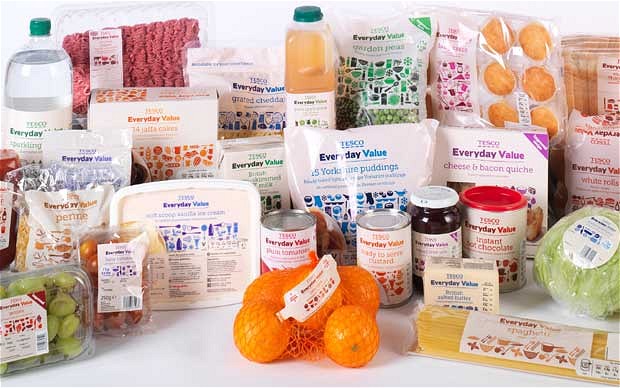
The range of value products is growing as are retailers efforts to explain to customers why they represent a good buy. Tesco say they “are proud to bring you Everyday Value – quality and value for everday eating, cooking and living”. Morrisons M Savers go flat out on communicating price, and visitors to their website are guided by price bands – under 30p, under 50p, and under £1.

At the other end, retailers are busy developing premium ranges that rely on provenance and quality of ingredients, like Sainsbury pasta which comes from a family firm in Puglia, Italy. Morrisons M Kitchen ready meal range has been developed by celebrity chefs.

Private label is also good for retailers in that, with the exception of Morrisons they own few production assets relying instead on suppliers to make the products. So if an idea does not work they do not bear the burden of factories lying idle, or workers laid off because demand was less than hoped.

Expect to see the private label battle intensify over the coming months, and branded suppliers to do much head scratching about how to fund both advertising to keep their brands front of mind with consumers, and cut price promotions demanded by retailers.


Friday, 14 September 2012

Multi Channel Retailing - Is It a "Must" For Success?


Multi channel retailing is business speak for offering customers more than one way to buy something be it a shop, mail order, online, or through a mobile phone. The concept is further confused by defining different types of shops as channels, so we have the convenience channel, the discount channel, and the standard mainstream grocery shop.

The words multi channel strategy appear in most major company reports and those not seen to be participating get criticised.

Morrisons supermarket has been lambasted because it is not represented in the fast growing channels of on line retailing and convenience stores, and this has led to a drop in sales and market share. On the other hand, Ocado which is solely available on line has been criticised for missing out on sales at peak periods because there are not enough hours in the day or vans available to deliver the increased amounts people have ordered.

Large retailers are investing £millions into multi channel development.  Although trialling food sale on line, and offering customers the opportunity to order online and collect in store, Walmart is putting most of its emphasis on opening stores – small ones in urban areas, medium sized stores for towns and more of the huge supercentres for which they are famous. Marks and Spencer has said that whilst web based channels are important they feel that stores will remain the core of their business.

New and eye catching digital developments are announced daily.  At Gatwick airport Tesco has built huge screens that look like a fridge and the idea is that holidaymakers waiting for their flight can scan products from the screens on to their phone, ping to Tesco, and have their groceries delivered immediately they arrive home again, cutting out the need to make a stop at the shops after a long tiring journey.

Certainly in today’s fast paced society there is something compelling about the notion that consumers must have a quick and easy way to purchase whatever time of day or night the urge strikes. The rapid growth of food shopping online, said by the Office of National Statistics to be 14-15% per annum compared with 3% for the market as a whole, and the explosion in ways to access the net whether through smart phones or tablets or the standard computer, seem to suggest that food retailers large and small should be seriously examining online retailing, or risk getting left behind.

Nevertheless, there are question marks over all this multi channel effort.  It is noticeable that whilst all retailers are keen to talk about sales growth, few mention profits, and indeed there is recognition among most retailers that online will never be as profitable as shops. There is little discussion of the different skills required to run different channels. And despite all the effort, the proportion of food retailing done through the internet remains small – around 2 or 3% according to Mark Price of Waitrose. Even mighty Tesco is estimated to have just 6% of sales made on line, and Sainsbury 4%. The fastest growing retailer of them all, Aldi, avoids online shopping possibly because the costs involved might mean they cannot continue offering the very low prices which makes them the success they are.

Anyone deciding to experiment with a new channel may first want to ensure that they are operating a secure, cash generative core business. It will be important to have the requisite skills in place, to capture all the costs associated with the new venture, to ring fence the investment and returns, and to accept that it will take time to achieve success.


Monday, 3 September 2012

The Co-op - Not Good With Food


If ever there was a company which should be flourishing in today’s economic climate it is the Co-op, yet last week it posted a 16% drop in its food business profits for the last 6 months. Like for like sales are down 1.2%, and market share is sliding.

The Coop should have much going for it. It operates in the convenience sector which is growing fast and is now worth nearly £34 billion or 21% of the UK food and grocery market, driven by factors such as consumers shopping locally to save on petrol costs, and the benefit of longer opening hours. With nearly three thousand stores it has a scale advantage that smaller shops envy, and it is Britain’s biggest farmer which should give it access to high quality food at reasonable prices. It also claims to be ethical in its sourcing policy.

Peter Marks, the Co-op’s chief executive, attributed the drop in profits to budget conscious consumers and a particularly competitive grocery trade, where over 40% of goods are sold on promotion. Well yes, but none of this is new news, and the Co-op has failed to deal with market place reality.

Price is not everything. If the Co-op offered something different and special then the fact that it is a bit more expensive would not be a stumbling block. A trip to several Co-op stores seems to indicate that what can be bought is anything but special. Despite the claim to be “Good with food”, there is a minimal amount of space dedicated to food, and what is available often looked tired and unappetising.
   
Add to this a sense that nothing new or exciting has happened to the Co-op food offering in years, and it is possible to see why shoppers might be tempted to pop down the road to a Tesco or Sainsbury or even Marks and Spencer and Waitrose who are all now operating in the convenience sector, and upping their game with a focus on value, innovation and good if not superb quality.

It is difficult to avoid the conclusion that the Co-op has been badly managed, and it is perhaps here that we see the downsides of the cooperative model where operators are insulated from shareholder pressure to improve performance. Indeed if the Coop were publicly quoted it would have faced demands for management changes and a strategy rethink. Instead, the chief executive has decided to retire at a time of his own choosing leaving a mess at the food business as well as a huge challenge on the banking side which also saw a big drop in profits and must now set about the huge task of integrating the Lloyds TSB branches it recently acquired.

Friday, 3 August 2012

Shopping at ALDI Again


Spurred on by reports of a return to booming sales through discount grocers and news that ALDI is so confident about its growth prospects that it intends to employ an additional 3000 people in the next year, I visited a brand new ALDI in leafy Stratford on Avon to work out why discounters are proving more popular than ever.

Discounters first came to national consciousness in 2008 as a way to save on groceries at a time of economic pressure.  When things got a bit better economically speaking in 2009/2010, discount supermarket sales levelled off. But now in the face of further economic challenges discount supermarkets ALDI and Lidl have come into their own again, and in the last 12 weeks according to Kantar Worldpanel, ALDI grew by 26% and Lidl by 11% when the total market was down by 2%. Now ALDI and Lidl have record brand shares of 2.9% each.

The IGD (Institute of Grocery Distribution) tells us that the number of people visiting a discounter in the last month grew from 35% in May 2011 to 42% in May 2012, and that 31% say they will shop again in the next month, up from 24% last year. Thus discounters are benefitting from more people through their doors as well as regular customers choosing to spend a bigger slice of their food budget in a discount shop.
Indeed according to IGD it is better off families with children who are frequenting discounters more often, with 39% of ABC1’s with children saying they will return to shop compared with 30% of CDE’s with children.


It is clear from the trip to Stratford that ALDI is moving away from its traditional business model.  It continues to sell most of its packaged  goods under brand names only available at ALDI , in pack designs remarkably close to the national brand equivalent but at prices significantly below that of the national brand or a supermarket own label offering. The ALDI ginger nuts pictured cost 29p, versus McVities at over a £1. The company has also started to bolster its price credentials through witty advertising.

However, it now stocks many more national brands than previously, including Tetley, Nescafe, Mars, and Cadbury.


In the fresh arena it has started to offer premium lines, mimicking the “good, better, best “ approach taken by bigger supermarkets. Thus we find a “Specially Selected” range featuring lines like West Country butter with sea salt crystals.

The store acknowledges trends such as free range eggs and chicken, and seems to be a supporter of British produce. The chicken was British as was beef and some cuts of pork, although not bacon or sausages. Packs featured the Union flag and Red Tractor logo.

Despite the move upmarket,  fresh food prices in most cases remain remarkably low. However, there are signs of an upward drift. Beef mince claiming less than 28% fat was £3.11p per kilo, compared with Tesco less than 25% fat at £3.00.

The products Aldi sells are changing, and there are signs that the way in which they sell them is changing too. Of those extra 3000 staff, many will be employed in existing stores which will mean an  increased cost. I noticed too that the old speedy and cost efficient way of checkout whereby customers cannot pack at the till but have to throw goods back in the trolley and pack on one side is changing too. In Stratford, customers were packing at the till, leading to long queues. Another change is the availability of baskets which again are more time consuming to checkout as well as taking up valuable selling space.

 Some things have not changed. Trolleys still cost £1, redeemable on return, which means no staff are needed to collect them from the car park. Product is still displayed in boxes to reduce staff time involved in stacking shelves.

 There is no doubt that ALDI is evolving to offer more of what customers seem to want. However the big thing which makes ALDI successful is the low prices they offer – if all the new ideas interfere with that they will lose not only those seeking bargains at a time of austerity, but their core budget conscious customers too. And that way lies disaster.